
 Product Catalog
16.12.25
On the market of battery packs for drones, copters, or other UAV systems, we usually see the 6s configuration. Why exactly? Let’s also look at some batteries
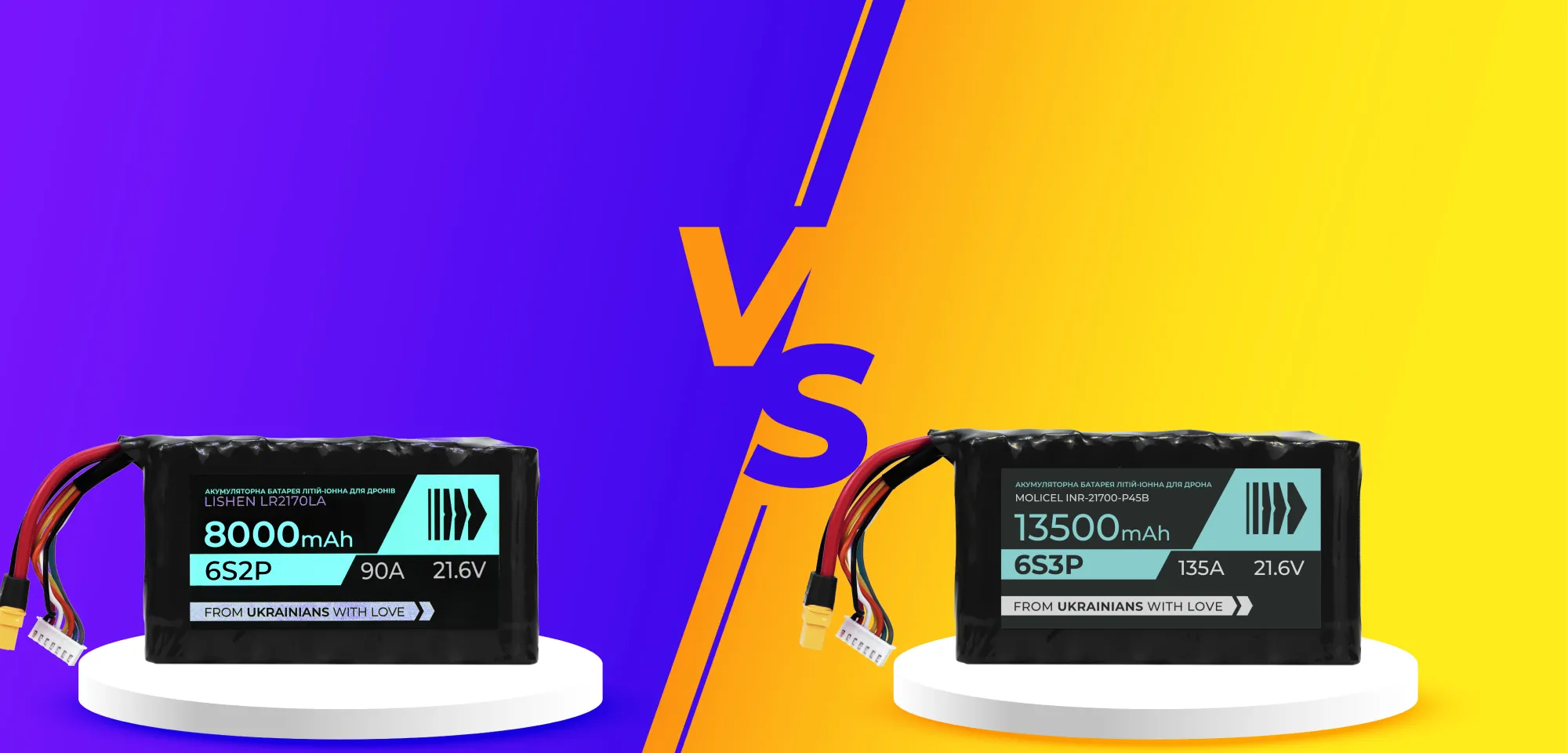
Why 6s Became the Standard for FPV Drones
What is most important in a battery for FPV drones? Capacity? Maybe weight or dimensions? Reliable power supply is what determines efficiency, flight time, and overall system performance. The 6s battery configuration (six cells connected in series) has become the de facto standard for most 5-inch and larger quadcopters.
The 6s configuration provides a nominal voltage of 22.2 V (fully charged — 25.2 V), which is significantly higher than the previously popular 4s configuration (nominal voltage 14.8 V, fully charged — 16.8 V). It is this higher voltage that we will focus on.
The main reason for switching to 6s: To achieve the same power (P = V * I) at higher voltage (V), a lower current (I) is required. Lower current flowing through components (ESC, motors, wires) leads to reduced heat generation and increased overall system efficiency. This allows FPV pilots to use lighter and smaller components or to extract more power from the equipment they already have. In addition, 6s provides a greater power reserve necessary for aggressive maneuvers and lifting heavier payloads.
About 4s and 5s:
- The 4s configuration is still used, mainly on smaller (3–4 inch) or lighter FPV drones. It is simpler to use and cheaper, but has limitations in maximum power and efficiency compared to 6s.
- The 5s configuration (nominal voltage 18.5 V) is rarely seen in the FPV community, but such batteries may be used in commercial drones such as DJI Mavic, where the priority is long and stable flight rather than high maneuverability and speed.
6s2p Batteries
The 6s2p configuration (six in series, two in parallel) is one of the most popular for FPV drones focused on long-range flights and extended flight time.
In this pack, two parallel cells double the overall capacity and maximum discharge current compared to a single cell (1p). Using high-current Li-ion 21700 cells (instead of Li-Po) allows achieving significantly higher energy density.
Which 6s2p packs we produce:
|
Cell |
Capacity of 6s2p pack (mAh) |
Max discharge current of 6s2p pack (A) |
Main application |
|
8000 |
90 |
Balanced option for one-time use, good price/quality ratio. |
|
| 8400 | 90 |
Optimal choice, higher power for better wind resistance. |
|
| 9000 |
Up to 100 |
Premium segment, best combination of capacity and power. |
|
| 10000 | 90 |
Premium segment with maximum capacity and longest flight time, for slow and stable missions. |
6s3p Batteries
The 6s3p configuration (six in series, three in parallel) is the choice for missions requiring longer flight duration and reliable power supply for heavier or specialized drones.
Thanks to three parallel cells, this pack provides greater capacity and maximum discharge current. This makes it significantly heavier, but also much more powerful and durable.
Main applications of 6s3p:
- Stationary or monitoring platforms: Drones that must remain airborne for the maximum possible time, often with large propellers and highly efficient motors.
- Extreme long-range flights: For missions requiring greater distance and flight time, where the extra weight is justified by increased energy.
Which 6s3p packs we produce:
| Cell |
Capacity of 6s3p pack (mAh) |
Max discharge current of 6s3p pack (A) |
Main application |
|
12000 |
135 |
Balanced endurance, good price/quality ratio. |
|
| 12600 | 135 |
High power and capacity for large FPV platforms. |
|
|
13500 |
150 |
Best performance for heavy drones requiring high current. |
|
|
15000 |
135 |
Maximum capacity and flight time for monitoring and stationary tasks. |
How to Choose Your Configuration?
Sometimes choosing between 6s2p and 6s3p can be difficult. It all depends on your mission priorities and drone characteristics.
- Define your priority — capacity or power:
- If you need maximum flight time and fly moderately, choose cells with high capacity, such as Samsung 50S.
- If higher power is required for fast acceleration or heavy payloads, choose cells with higher peak currents.
- Assess the required current:
- 6s2p — this is the conditional standard for most FPV drones. It provides sufficient flight time for most typical missions at acceptable weight and enough current for 5–7 inch FPVs.
- 6s3p — this choice is suitable for heavier drones or missions requiring high capacity. Remember that 6s3p will be heavier, and your drone must have sufficiently powerful motors and propellers to effectively lift this weight.
News and Reviews


01/09/2026
Top News for the Morning of September 1, 2026. Russia is using tactics of attrition against Kyiv
BTRY.ENERGY offers news and articles in Ukrainian with a focus on preserving Ukrainian identity, citizens' rights, and t...

31/08/2026
Pentagon: Arsenal to be expanded
BTRY.ENERGY offers news and articles in Ukrainian with a focus on preserving Ukrainian identity, citizens' rights, and t...

31/08/2026
Three major American publications focus on Ukraine. Why does this matter?
BTRY.ENERGY offers news and articles in Ukrainian with a focus on preserving Ukrainian identity, citizens' rights, and t...
31/08/2026
Top News for the Morning of August 31, 2026. The world has finally entered a global conflict
BTRY.ENERGY offers news and articles in Ukrainian with a focus on preserving Ukrainian identity, citizens' rights, and t...

28/08/2026
A new nuclear technology: micro-reactors. Why is this important?
BTRY.ENERGY offers news and articles in Ukrainian with a focus on preserving Ukrainian identity, citizens' rights, and t...
28/08/2026
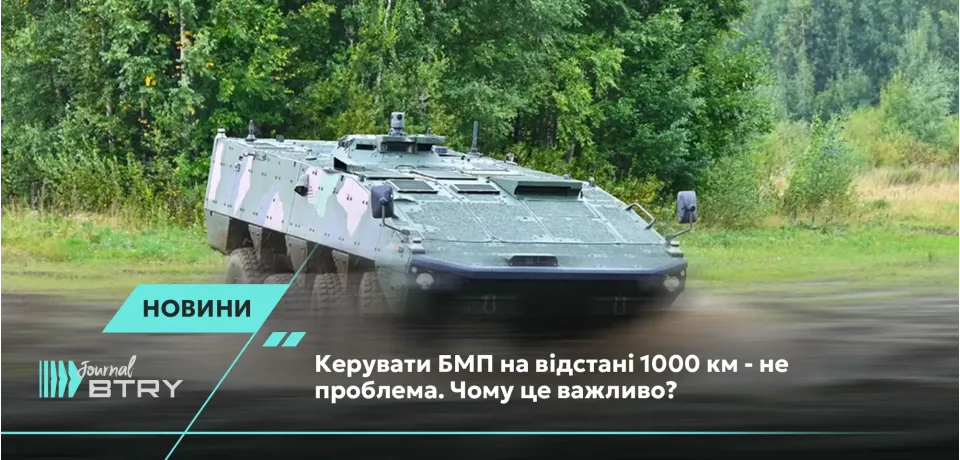
Operating an infantry fighting vehicle (IFV) from a distance of 1,000 km is not a problem. Why is this important?
BTRY.ENERGY offers news and articles in Ukrainian with a focus on preserving Ukrainian identity, citizens' rights, and t...
Consultation
Need more information?
Would you like to learn more about BTRY.ENERGY or get a personal consultation - fill out the form and we will contact you


