
 Product Catalog
20.11.25
How dangerous can lithium batteries be? What to do in case of swelling, hissing, or smoking of a battery inside various equipment?
Currently, lithium-based batteries are used in almost all modern technology — from portable devices to electric vehicles and charging stations. Their high energy density, while being an advantage, also carries risks. The main risk of such batteries is thermal runaway — an uncontrolled chain reaction that leads to severe heating, release of toxic gases, ignition, and in some cases, explosion.
Given the potential danger of any modern battery, people need to understand the differences between chemical compositions and know clear action protocols to protect their lives and property.
Let us analyze three common lithium battery chemistries — Li-ion, Li-NMC, and LiFePO4.
Lithium-ion: phones, power banks, FPV drone packs
Lithium-ion batteries have high energy density and are widely used in portable electronics such as phones and power banks, while the military uses them to power FPV drones, copters, and UAVs.
When the internal temperature of the battery reaches about 150–200°C, the cathode begins to release a significant amount of oxygen during decomposition, which in turn feeds the fire. A characteristic sign is swelling of the battery casing (the so-called “acute pillow”), indicating gas accumulation and inevitable loss of hermeticity, which may lead to explosion or ignition.
Action protocol for overheating and swelling Li-ion
- Immediate isolation. Move the device as quickly as possible onto a non-flammable surface, away from people, combustible materials, and flammable liquids.
- Avoid puncturing. It is strictly forbidden to puncture a swollen battery, as this will instantly release gases, cause ignition, and likely an explosion.
- Cooling. If the situation is not yet out of control, try to carefully cool it down, for example by placing it in a bucket of sand or covering it with a metal object. Water may be used for cooling, but not for extinguishing the fire itself.
- Act quickly. Swelling is a critical sign. The time for reaction is extremely limited.
Li-NMC: Electric cars, EW, C2 systems
Nickel-manganese-cobalt (Li-NMC) batteries are often used to power electronic warfare and command-and-control systems. In civilian life, these cells are used in most modern electric vehicles. They have low thermal stability, and their thermal runaway is among the most dangerous.
An NMC battery fire is characterized by intense flames that are difficult to extinguish and the release of large amounts of highly toxic gases. Thermal runaway in Li-NMC begins at approximately the same temperature as in Li-ion. Characteristic signs of runaway for this chemistry include: hissing, smoke, strong heating, and odor.
Action protocol for hissing Li-NMC
- IMMEDIATE EVACUATION. Hissing in an NMC battery is a sign that thermal runaway has already started or is imminent. This is a critical situation requiring immediate evacuation of all people from the danger source.
- Time to escape. Depending on the battery design and cooling system, you may have from several seconds to a few minutes before full ignition. Modern EV batteries have systems to slow down the process, but safe evacuation and moving to a safe distance is the priority.
- Safe distance. It is necessary to move at least 15–20 meters away due to the risk of flame ejection and toxic gases.
- Military context. If this is a military battery or equipment, initiation of thermal runaway may be used as a destruction method if the object cannot be evacuated. A battle-damaged battery or any other device should be abandoned immediately, since combat damage (shrapnel, bullets) can cause internal short circuits and immediate thermal runaway.
LiFePO4: Charging stations, autonomous power systems
Lithium iron phosphate (LiFePO4 or LFP) batteries are considered the safest among lithium-ion technologies due to their high thermal stability. Thermal runaway in LiFePO4 cells usually initiates at much higher temperatures (around 270°C) compared to other chemistries.
The key difference is that the LiFePO4 cathode releases minimal oxygen during decomposition, making the reaction less intense. The risk of explosion is extremely low; a more likely scenario is smoking. Warning signs include: smoke, strong heating, unpleasant odor.
Action protocol for smoking charging station (LiFePO4)
- Evacuation and ventilation. Smoke from any lithium battery is toxic and contains hazardous substances, including hydrogen fluoride. Immediately move to a safe distance (at least 5–10 meters, if possible) and ensure maximum ventilation of the room or shelter.
- Isolation. If safe, move the equipment onto a non-flammable surface (concrete, metal, soil) away from combustible materials.
- Extinguishing and cooling. In the case of large systems, such as a charging station, large amounts of water are the best means to cool neighboring cells and prevent the spread of thermal runaway. ABC or CO2 fire extinguishers may be used to suppress flames, but water is more effective for cooling.
General recommendations
Smoke from all lithium batteries is highly toxic. It contains hazardous substances, including hydrogen fluoride, which upon contact with moisture (for example, in the lungs) turns into hydrofluoric acid. Always avoid inhaling smoke and, if possible, use respiratory protection.
In critical situations, especially with large batteries, large amounts of water are the best means to cool neighboring cells and prevent the spread of thermal runaway. Water does not extinguish the chemical reaction inside the cell, but it lowers the temperature of surrounding cells, stopping the chain reaction.
News and Reviews


01/09/2026
Top News for the Morning of September 1, 2026. Russia is using tactics of attrition against Kyiv
BTRY.ENERGY offers news and articles in Ukrainian with a focus on preserving Ukrainian identity, citizens' rights, and t...
31/08/2026
Pentagon: Arsenal to be expanded
BTRY.ENERGY offers news and articles in Ukrainian with a focus on preserving Ukrainian identity, citizens' rights, and t...
31/08/2026
Three major American publications focus on Ukraine. Why does this matter?
BTRY.ENERGY offers news and articles in Ukrainian with a focus on preserving Ukrainian identity, citizens' rights, and t...
31/08/2026
Top News for the Morning of August 31, 2026. The world has finally entered a global conflict
BTRY.ENERGY offers news and articles in Ukrainian with a focus on preserving Ukrainian identity, citizens' rights, and t...
28/08/2026
A new nuclear technology: micro-reactors. Why is this important?
BTRY.ENERGY offers news and articles in Ukrainian with a focus on preserving Ukrainian identity, citizens' rights, and t...
28/08/2026
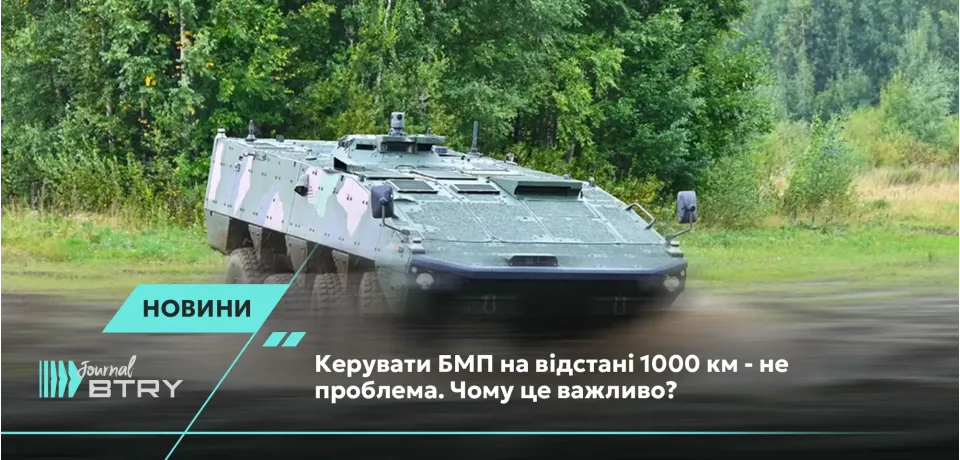
Operating an infantry fighting vehicle (IFV) from a distance of 1,000 km is not a problem. Why is this important?
BTRY.ENERGY offers news and articles in Ukrainian with a focus on preserving Ukrainian identity, citizens' rights, and t...
Consultation
Need more information?
Would you like to learn more about BTRY.ENERGY or get a personal consultation - fill out the form and we will contact you


