
 Product Catalog
21.10.25
We’ll discuss what typical faults Li-ion batteries may have, what methods exist to detect them, and how to avoid them.

Lithium-ion (Li-ion) batteries are widely used in both civilian and military sectors. A characteristic feature of Li-ion is high energy density per unit mass with relatively low weight. And although we’ve long been familiar with batteries of this chemistry, many still may not understand how to assess the condition of a battery and whether it’s fit for use. Let’s figure out what’s needed to easily determine the state of your battery.
To assess battery condition, three main indicators are used: capacity (how much energy the battery can store), internal resistance (ability to deliver current), and self-discharge rate (a sign of mechanical damage or chemical issues). And although there’s no single device that can quickly and reliably check battery condition all at once, some hidden defects and faults are easy to recognize.
Internal problems (manufacturing defects, metal impurities, etc.) and external factors (impacts, overheating, overload, humidity) affect the performance of all types of Li-ion. For example, heat, severe cold, excessive charging, deep discharge, or physical impacts harm your battery and reduce its service life.
Typical Faults of Lithium-Ion Batteries
During operation, Li-ion batteries most often encounter the following issues: gradual loss of capacity (charge volume decreases), increased internal resistance (ability to deliver current drops), overheating of the casing and gas formation (causing swelling), electrolyte leakage and corrosion, as well as short circuits (external or internal). In all cases, battery performance and reliability are seriously reduced.
- SEI film buildup: Over time, a layer of solid electrolyte interface (SEI) grows on the negative electrode. At a fixed current output, voltage holds worse, maximum current decreases, and the battery heats up during operation. This process leads to gradual capacity loss and overall battery aging.
- Lithium plating (“creeping” lithium): If the battery is charged too quickly or deeply discharged, metallic lithium may deposit on the anode. It settles in the form of thin flakes (dendrites), which penetrate through the separator and cause internal short circuits. This condition is easy to identify by sudden voltage drops and element overheating.
- Uneven aging: Even under identical conditions, different battery cells degrade at different rates. This leads to voltage imbalance in series connections. It manifests as significant divergence in cell voltages, and the battery delivers charge unevenly.
- Increased internal resistance and corrosion: Over time and under poor conditions, internal resistance may increase, and microcracks may form on the electrodes. This results in problems with current delivery and causes additional heating. The battery’s external appearance shows signs of galvanic corrosion—such as blackening on galvanic contacts.
- Electrolyte leakage and deformation: Physical damage may lead to fluid leakage. It’s easy to detect when wet spots appear on the casing. Also, gas buildup due to side reactions leads to swelling. These signs serve as clear visual markers of internal battery problems.
Diagnostic Methods for Lithium-Ion Batteries
Effective diagnostics are performed in several stages. It starts with visual inspection. The casing, electrode terminals, and connections are examined for visible defects: swelling or delamination of packaging, cracks, fluid leaks, blackened contacts, or corrosion. Such signs indicate internal damage.
Next, electrical tests are applied. The first is voltage check. To do this, the battery is fully charged, then the voltage of individual cells is measured with a multimeter. In a normal Li-ion cell, voltage lies in the range of ≈3.6–4.2 V. If any value is significantly lower (e.g., <3.0 V), this indicates deep discharge or capacity loss.
Another standard method is the capacity test (discharge test). After fully charging the battery, its cells are connected to a standard load and discharge time to threshold voltage is measured. In normal condition, cells discharge at approximately the same rate, while damaged ones discharge much faster or slower. The time difference indicates lost capacity.
Next, internal resistance is measured. A special internal resistance meter or a multimeter in milliohm mode is used. The test is conducted under light load and voltage drop is recorded. In a normal Li-ion cell, internal resistance is several tens of milliohms (usually <50 mΩ). If any cell has significantly higher resistance, this indicates degradation or damage. High internal resistance leads to stronger heating under load and signals increased risk of failure.
Another simple test is voltage balance analysis. After charging, the battery is left idle for a while, then individual cell voltages are measured. In a functional battery, the discrepancy between them will be minimal. If one or more cells show clear lag, this indicates imbalance.
How to Avoid Faults
It’s important to use a Battery Management System (BMS). Modern batteries and charging stations have a built-in board that constantly measures voltage, current, and temperature of each cell. BMS can issue warnings/errors about imbalance or overheating. The presence of BMS greatly simplifies diagnostics: based on controller data, it’s easy to identify a cell with elevated resistance or voltage deviation. In laboratory conditions, advanced diagnostics also use methods like electrochemical impedance spectroscopy (EIS), ultrasonic testing, and thermal scanning, which help detect internal defects in advance.
News and Reviews



01/09/2026
Top News for the Morning of September 1, 2026. Russia is using tactics of attrition against Kyiv
BTRY.ENERGY offers news and articles in Ukrainian with a focus on preserving Ukrainian identity, citizens' rights, and t...

31/08/2026
Pentagon: Arsenal to be expanded
BTRY.ENERGY offers news and articles in Ukrainian with a focus on preserving Ukrainian identity, citizens' rights, and t...

31/08/2026
Three major American publications focus on Ukraine. Why does this matter?
BTRY.ENERGY offers news and articles in Ukrainian with a focus on preserving Ukrainian identity, citizens' rights, and t...

31/08/2026
Top News for the Morning of August 31, 2026. The world has finally entered a global conflict
BTRY.ENERGY offers news and articles in Ukrainian with a focus on preserving Ukrainian identity, citizens' rights, and t...

28/08/2026
A new nuclear technology: micro-reactors. Why is this important?
BTRY.ENERGY offers news and articles in Ukrainian with a focus on preserving Ukrainian identity, citizens' rights, and t...
28/08/2026
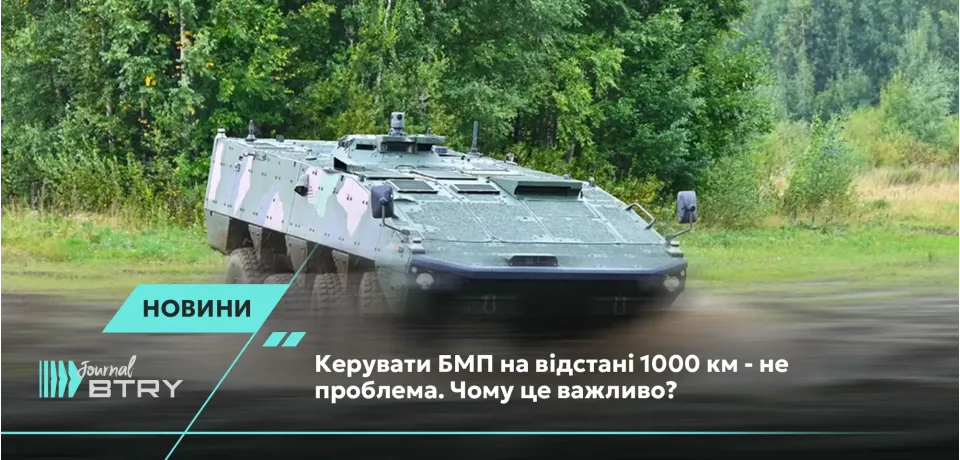
Operating an infantry fighting vehicle (IFV) from a distance of 1,000 km is not a problem. Why is this important?
BTRY.ENERGY offers news and articles in Ukrainian with a focus on preserving Ukrainian identity, citizens' rights, and t...
Consultation
Need more information?
Would you like to learn more about BTRY.ENERGY or get a personal consultation - fill out the form and we will contact you


