
 Product Catalog
27.06.25
One of the most common reasons for equipment failure in field conditions is batteries that lose capacity or fail due to improper charging. When every hour counts, a charging device isn’t just an accessory — it’s a matter of system resilience
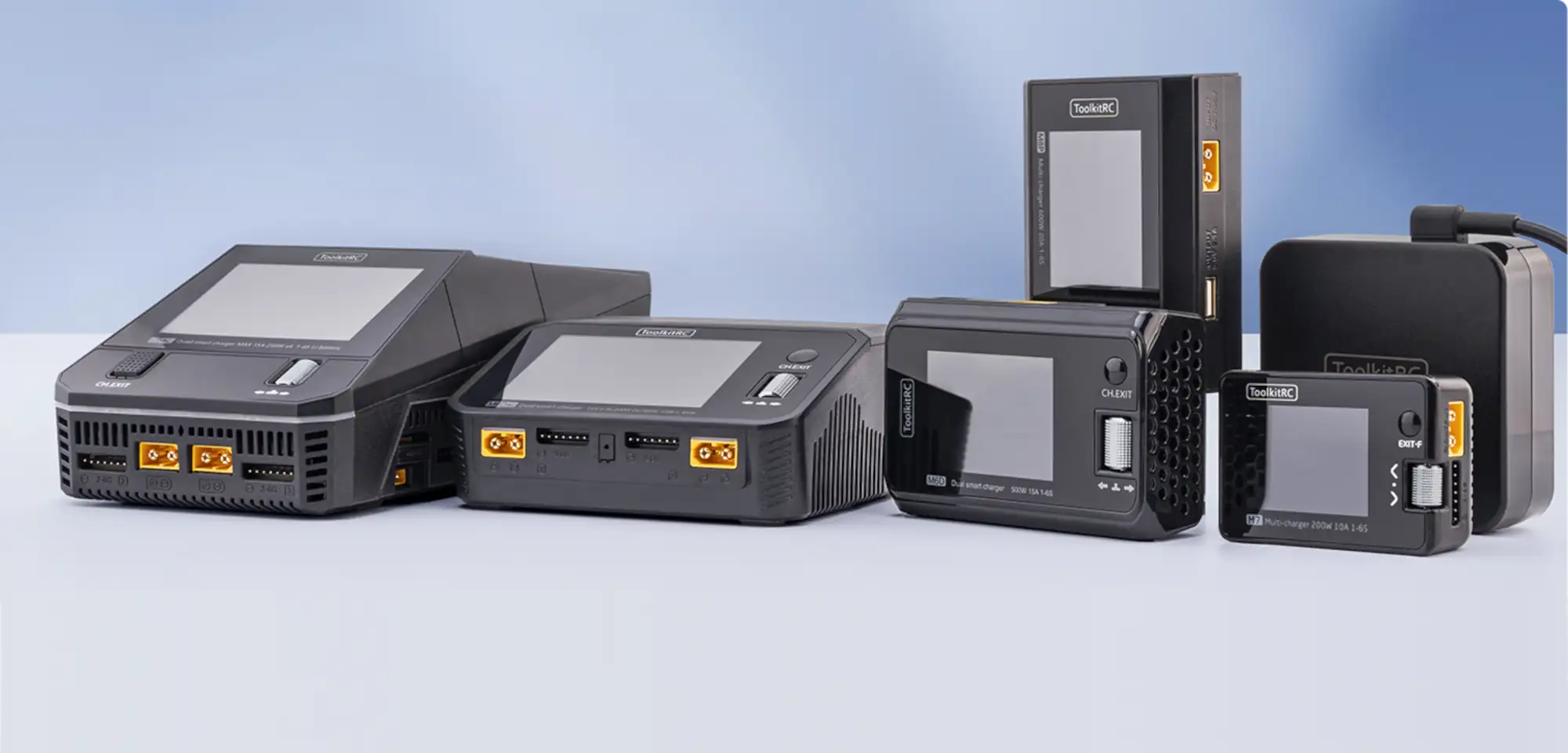
A few years ago, most batteries were charged “as convenient” — without temperature control, cell balancing, or real-time assessment of internal status. But with the advancement of lithium chemistries and increasingly complex battery assemblies, the need arose for a separate class of equipment: smart, flexible, and multifunctional charging solutions.
Among such solutions, ToolkitRC stands out. Their devices combine charging, diagnostics, signal testing, power delivery, and sometimes serve as a “field laboratory” for battery systems. This article explores why, without a quality charger, any battery pack becomes a liability — and how ToolkitRC has become an integral part of the technical infrastructure for volunteer and military units in Ukraine.
From simple power adapter to life-supporting tool
There’s no way around it today — charging is essential. Batteries are not just energy sources, but complex systems requiring precise control. This is especially true for lithium-based packs: every battery must be balanced, or else face degradation, overheating, and sudden failure.
Some battery assemblies include a built-in BMS (Battery Management System) that handles protection and balancing — allowing even a basic adapter to charge them safely. But most field solutions, especially FPV drones, multicopters, and various UAVs, use packs without a BMS, relying only on a balance cable. And for those, “plugging into a wall” isn’t an option. It’s not only ineffective — it can lead to irreversible damage.
In response to this challenge, specialized chargers emerged — devices that do more than fill cells: they control the process, balance individual cells, and assess internal parameters. As FPV systems, UAVs, and military-grade autonomous modules evolved, so did the demand for high-end charging. ToolkitRC entered the scene with a clear mission: not just deliver power, but deliver technical advantage.
Today, their devices include mini oscilloscopes, signal testers, power supplies, resistance meters, and support for all popular chemistries — from lithium-ion variants to NiMH and lead-acid. These tools have become the cornerstone of stable power infrastructure wherever consistency matters most.
Types of chargers and what they can do
A typical user often only cares if a charger “works” and “turns on.” But field operations require more. That’s why modern chargers fall into several categories, each with its role:
- Single-channel chargers – Basic model for working with one pack. Compact and efficient, but limits throughput.
- Multi-channel chargers – Charge several batteries simultaneously, sometimes with varying parameters. Ideal for workshops or mobile hubs handling multiple devices.
- Balancing chargers – Actively equalize voltage between individual cells. Essential for longevity, safety, and preventing overheating — especially for LiPo and Li-ion.
- Smart chargers with diagnostics – Not just chargers, but tools: measure internal resistance, voltage, signal logic, and communication health. Can detect problems early — before battery failure.
- Combined solutions (like ToolkitRC M8P) – Combine charger, power supply, signal tester, balancer, and voltmeter in one. Perfect for “many tasks — one device” setups, especially where mobility matters.
Lightweight and ultra-mobile: ToolkitRC M7
When weight and space are limited, enter the ToolkitRC M7. This compact charger weighs only 90 g and fits in a pocket, yet its capabilities are impressive:
- Power: Up to 200 W at 10 A — enough for most FPV batteries
- Supported chemistries: LiPo, LiHV, LiFe, Li-ion (up to 6S), plus NiMH and Pb
- Balancing: Up to 6S, 400 mA balance current
- Features: Internal resistance measurement, PWM/PPM/SBUS signal testing, power supply mode
- Interface: 2" IPS display, scroll wheel navigation, USB for firmware updates
This isn’t just a “drone charger” — it’s a mobile lab: test batteries, check ESCs, power communication modules — all in a box the size of a matchbox.
When to use? Perfect for field conditions requiring mobility — scouting, FPV ops, remote maintenance.
Dual-channel power: ToolkitRC M6DAC
When two batteries need charging simultaneously — with different specs — the ToolkitRC M6DAC rises to the challenge. A dual-channel charger offering flexibility and serious output:
- Power: 350 W per channel or 700 W synchronized, up to 25 A
- Input: Works on AC (100–240V) or DC (7–28V) — field-ready
- Supported chemistries: LiPo, LiHV, LiFe, Li-ion (up to 6S), NiMH, Pb
- Balancing: Up to 6S, 1000 mA balance current, <0.005V accuracy
- Features:
- Lab-grade power output with adjustable voltage
- USB-C PD/QC up to 65 W for charging laptops or cameras
- Internal resistance, voltage, and temperature measurement
- Interface: 3.5" IPS display, scroll wheel, intuitive menu
Distinguishing factor? A semi-stationary setup suited for workshops and mobile command hubs. M6DAC charges batteries for UAVs, radios, and comms modules — saving time and maximizing output.
When to use? In volunteer centers, technical crews, and mobile repair stations — where efficiency and time are mission-critical.
For high-voltage tasks: ToolkitRC M8P
The ToolkitRC M8P is a true multi-tool. It’s chosen not just for charging, but for full power system control — from signal testing to diagnosing high-draw battery assemblies.
- Power: Up to 600 W at 30 A — charges lithium batteries up to 8S
- Supported chemistries: LiPo, LiHV, LiFe, Li-ion, NiMH, Pb
- Balancing: Up to 8S, 1000 mA, <0.005V accuracy
- Input: DC (7–28V), plus power supply mode for stable output
- Features:
- Signal tester: PWM, PPM, SBUS, CRSF
- Internal resistance, voltage, and temperature diagnostics
- Servo tester, oscilloscope mode for signal analysis
- Interfaces: 2.4" IPS display, scroll wheel, USB port for updates
The M8P is a compact charging station that powers communication modules, diagnoses issues, checks servos, and supplies voltage to microcontrollers or switching systems — all in a field-ready package.
When to use? Servicing drones, EW systems, radios, navigation tools — the M8P is the go-to for volunteers, technicians, and tactical teams.
Versatility matters
Modern chargers come in many forms — from pocket-sized tools to high-capacity stations supporting diagnostic capabilities and multi-cell balancing. Each one serves a purpose: mobility, workshop efficiency, or tactical readiness. ToolkitRC’s multifunctional devices let users not only charge, but manage power, test batteries, analyze signals, and deliver stable voltage to various systems.
This diversity isn’t just about convenience. It’s about adaptability, technical flexibility, and reliable power delivery — especially in field conditions where every battery is a strategic asset. In the field, the workshop, or the volunteer base — robust charging gear is always working toward the mission.
More to come
This article is just the first step toward understanding why charging devices have become a vital part of field-ready infrastructure. In future publications, we’ll explore specific ToolkitRC models in depth: highlight their strengths, compare their functions, and analyze use cases in volunteer and military applications.
Charging equipment isn’t just a tool. It’s about technical responsibility, operational resilience, and knowing how to preserve battery life where it truly matters. We’ll show you how to choose the right solution.
News and Reviews


01/09/2026
Top News for the Morning of September 1, 2026. Russia is using tactics of attrition against Kyiv
BTRY.ENERGY offers news and articles in Ukrainian with a focus on preserving Ukrainian identity, citizens' rights, and t...

31/08/2026
Pentagon: Arsenal to be expanded
BTRY.ENERGY offers news and articles in Ukrainian with a focus on preserving Ukrainian identity, citizens' rights, and t...

31/08/2026
Three major American publications focus on Ukraine. Why does this matter?
BTRY.ENERGY offers news and articles in Ukrainian with a focus on preserving Ukrainian identity, citizens' rights, and t...

31/08/2026
Top News for the Morning of August 31, 2026. The world has finally entered a global conflict
BTRY.ENERGY offers news and articles in Ukrainian with a focus on preserving Ukrainian identity, citizens' rights, and t...

28/08/2026
A new nuclear technology: micro-reactors. Why is this important?
BTRY.ENERGY offers news and articles in Ukrainian with a focus on preserving Ukrainian identity, citizens' rights, and t...
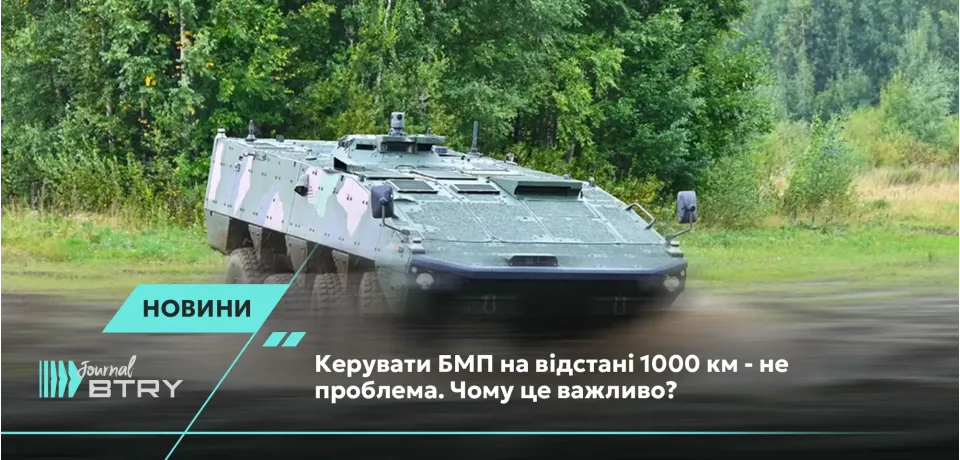
28/08/2026
Operating an infantry fighting vehicle (IFV) from a distance of 1,000 km is not a problem. Why is this important?
BTRY.ENERGY offers news and articles in Ukrainian with a focus on preserving Ukrainian identity, citizens' rights, and t...
Consultation
Need more information?
Would you like to learn more about BTRY.ENERGY or get a personal consultation - fill out the form and we will contact you


