
 Product Catalog
21.01.26
Practical methods of protecting lithium-ion (Li-ion) and lithium-polymer (Li-Po) batteries from cold, based on experience gained during the war in Ukraine, as well as international technical and military recommendations

Impact of Low Temperatures on Li-ion Batteries
Low temperatures slow down chemical reactions inside the battery, which leads to significant problems. The most noticeable is the reduction of available capacity, which can reach 20% at 0°C and over 50% at -20°C. In addition, the internal resistance of the battery increases significantly, limiting its ability to deliver high current, which is necessary for unmanned aerial vehicles (UAVs) at the front.
Charging the battery at temperatures below 0°C is strictly not recommended. This process can cause electrochemical deposition of metallic lithium on the anode. This damage is irreversible, leads to battery degradation, and significantly increases the risk of internal short circuit and fire.
Practical Protection Methods: Field Experience of Ukraine
In combat conditions, where access to specialized equipment is limited, Ukrainian soldiers and volunteers have developed a number of effective, improvised solutions to maintain battery performance.
Thermal Insulation and Passive Heating
For small batteries (for radios or FPV drones), the simplest and most effective method is to store them close to the body in inner pockets of clothing. Body heat maintains the battery temperature in the optimal range (+20-30°C), which helps preserve capacity. For transportation and storage, thermal bags (often ordinary cooler bags) or homemade thermal boxes insulated with foil-coated polystyrene (isolon) are used.
One of the most common means of active heat support is the use of chemical warmers. These disposable or reusable warmers, activated by air, are placed inside thermal bags or directly under the battery cover. They can maintain heat for 6-10 hours, which is sufficient to complete a combat mission.
UAV Operation Features
Experience of using drones (Mavic, FPV) in winter requires strict adherence to battery operation rules:
- 40% Rule: In winter, the drone should return to base when the battery charge level reaches 40%, whereas in summer this figure is 20%. This is due to the risk of a sharp voltage drop ("sag") under load in the cold, which can lead to uncontrolled crash of the aircraft.
- Pre-flight Heating: Before takeoff, the battery must be warmed to a temperature above 15°C. This can be done by holding it under the arm, placing it under the windshield of a car with the heater on, or using warmers.
- Motor Warming: After starting the drone, it is recommended to let it run at low speed for 30-60 seconds without takeoff. This creates a small load, which causes self-heating of the battery, improving its performance before the main flight.
Energy Saving for Starlink
For Starlink satellite communication systems, the main problem is high energy consumption in winter.
- Snow Melt Mode: The snow melting function (Snow Melt) can increase energy consumption up to 175 W. In conditions of limited power supply from batteries and generators, this mode is recommended to be turned off in the application settings (Starlink App -> Settings -> Starlink -> Snow Melt -> Off), if there is no heavy snowfall.
- Power Stabilization: When charging large battery systems from generators, which may have unstable voltage, stabilizers must be used. Cold batteries are especially sensitive to voltage fluctuations.
Professional and Technological Solutions (International Experience)
International technical standards and commercial solutions offer more technological approaches to heating batteries, which can be adapted for field conditions.
- Heating Pads (12V)
Flexible heating mats powered by 12V (similar to those used for seat heating). They can be integrated into thermal boxes. Often have a built-in thermostat that automatically maintains the temperature above 0°C, preventing damage during charging. - Battery Blankets / Jackets
Special electric "blankets" or thermal covers with heating. Used for large batteries (for example, LiFePO4 for backup power systems). Provide uniform heating and high efficiency. - Aluminum Heat Spreaders
Aluminum plates placed between the heating element and the battery. Provide uniform heat distribution over the entire surface of the battery, minimizing the risk of local overheating, which can damage the cells. - Phase Change Materials (PCM)
Materials that absorb or release heat during phase change (for example, special salts). A passive method that maintains stable battery temperature for a long time without external power.
Military Standards and Recommendations
Military standards such as MIL-STD-810G confirm the need for external heating. According to these requirements, lithium batteries without heating can lose up to 50% of capacity at -18°C. It is recommended to maintain the battery temperature above 0°C during operation and charging.
Action Algorithm for Protecting a "Non-adapted" Battery
To protect a regular Li-ion battery that does not have built-in heating systems, the following algorithm should be followed:
- Charging and Storage: Never leave the battery discharged in the cold. A discharged battery left in frost can be irreversibly damaged. Maintain charge level above 50%.
- Creating a Thermos: Use available materials (foam, old clothes, sleeping pad) and foil (for heat reflection) to create an insulating cover or box.
- Using External Heat: Place a heat source (chemical warmer or a bottle of warm water wrapped in cloth) inside the insulating box next to the battery.
- Charging: If the battery is frozen, charge it only after it naturally warms up to room temperature (or at least above 5°C). This may take 2-4 hours. Attempting to charge a frozen battery will lead to irreversible damage.
Solution from BTRY.ENERGY
We have developed our own specialized solution for protecting batteries in the cold. We offer you our thermal container. This container can store batteries for up to 8 hours at -20°C. It works very simply: the thermal container evenly heats the internal space to +18°C and maintains this temperature during its operation. It is also designed in such a way that it does not emit heat outside, meaning it is invisible to thermal imagers.
News and Reviews


01/09/2026
Top News for the Morning of September 1, 2026. Russia is using tactics of attrition against Kyiv
BTRY.ENERGY offers news and articles in Ukrainian with a focus on preserving Ukrainian identity, citizens' rights, and t...
31/08/2026
Pentagon: Arsenal to be expanded
BTRY.ENERGY offers news and articles in Ukrainian with a focus on preserving Ukrainian identity, citizens' rights, and t...
31/08/2026
Three major American publications focus on Ukraine. Why does this matter?
BTRY.ENERGY offers news and articles in Ukrainian with a focus on preserving Ukrainian identity, citizens' rights, and t...
31/08/2026
Top News for the Morning of August 31, 2026. The world has finally entered a global conflict
BTRY.ENERGY offers news and articles in Ukrainian with a focus on preserving Ukrainian identity, citizens' rights, and t...

28/08/2026
A new nuclear technology: micro-reactors. Why is this important?
BTRY.ENERGY offers news and articles in Ukrainian with a focus on preserving Ukrainian identity, citizens' rights, and t...
28/08/2026
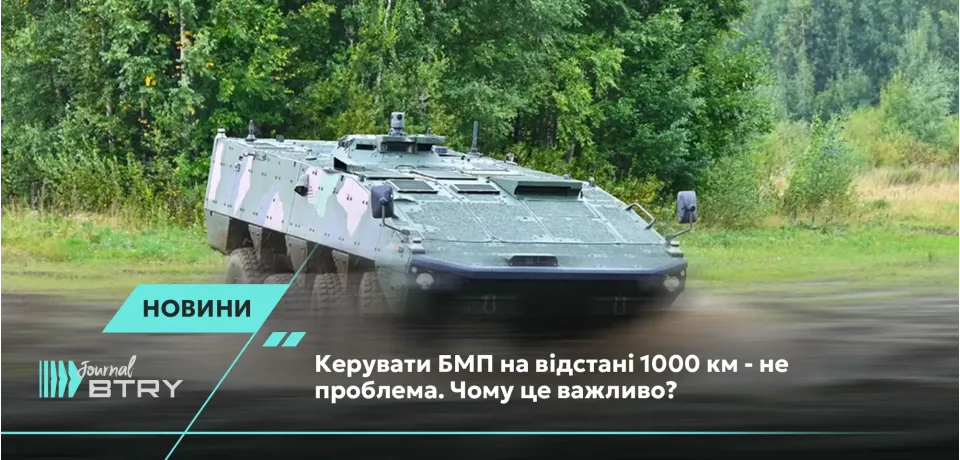
Operating an infantry fighting vehicle (IFV) from a distance of 1,000 km is not a problem. Why is this important?
BTRY.ENERGY offers news and articles in Ukrainian with a focus on preserving Ukrainian identity, citizens' rights, and t...
Consultation
Need more information?
Would you like to learn more about BTRY.ENERGY or get a personal consultation - fill out the form and we will contact you


