
 Product Catalog
10.02.26
Every smartphone user knows what “Fast Charging” is. But does everyone know that it can differ? For example, what is the difference between “Fast Charge” and “Super Fast Charge”? Don’t know? Let’s figure it out together

What are Fast Charge and Super Fast Charge?
Although these terms are often used as general names, they have specific technical meanings:
- Fast Charge is standard fast charging that provides power up to 15 W – 18 W.
- Super Fast Charge is a more advanced technology that can provide power up to 25 W and will charge devices almost twice as fast.
- Super Fast Charge 2.0 is the charging technology used by modern Samsung flagships. It provides power up to 45 W.
However, you should not rush to choose the fastest option. The reason why rushing would be a bad idea is that your device, whether it is a smartphone, tablet, or something else, may not support such ultra-fast charging.
How does ultra-fast charging work?
Let’s break down the operating principle of the entire process step by step:
- When the device is connected, the charging adapter and the device exchange data via the USB protocol. Usually, this is the Power Delivery (PD) protocol.
- Then the charger receives information from the device about:
- the current battery charge level,
- the temperature of the power cells.
- Based on this data, the charger determines the optimal power level for supplying energy.
It is also important to note that this field is developing, and new standards now exist, for example, Programmable Power Supply (PPS).
PPS enables dynamic adjustment of voltage and current in real time.
This allows the adapter to maintain power parameters as close as possible to the battery’s needs, reducing thermal load and increasing charging efficiency.
What is required for implementation?
For Super Fast Charge to operate, all three components must support the standard:
- The device being charged.
It must have the appropriate power controller. If a device supports, for example, 25 W, this means that it will charge quickly. - Next is the charger, or adapter.
It must support the protocol (for example, Power Delivery). In principle, this already means that its output power will also be 25 W or more and will be sufficient for fast charging. - Finally, but possibly underestimated, is the cable.
Usually, for power up to 60 W, a good USB-C cable is sufficient. However, for higher power, the cable must also be rated for 5 A.
Main advantages of ultra-fast charging
People often experience “battery anxiety.” This is the fear that the device will run out of power when you need it. Previously, when fast charging did not yet exist, people charged their devices “just in case.” It was common for a phone to remain plugged in all night, even if it was not heavily discharged. And all of this was simply to feel confident about the next day.
Ultra-fast/Super Fast charging changes this. It allows charging when it is directly necessary. Low battery charge is no longer a major problem. This creates a new way of thinking, where you do not worry about percentages but feel a greater sense of freedom and calmly plan your day as it suits you.
BTRY.ENERGY Offers
Of course, we are happy to talk about interesting things. But we also have ultra-fast charging (Super Fast Charge) solutions that we can offer you. Our range includes power banks that support the same Power Delivery protocol. We have:
Without going into details, we assembled these models ourselves. We can proudly state that during the assembly process we use only original cells and confidently provide a warranty of up to 6 months.
News and Reviews


01/09/2026
Top News for the Morning of September 1, 2026. Russia is using tactics of attrition against Kyiv
BTRY.ENERGY offers news and articles in Ukrainian with a focus on preserving Ukrainian identity, citizens' rights, and t...

31/08/2026
Pentagon: Arsenal to be expanded
BTRY.ENERGY offers news and articles in Ukrainian with a focus on preserving Ukrainian identity, citizens' rights, and t...

31/08/2026
Three major American publications focus on Ukraine. Why does this matter?
BTRY.ENERGY offers news and articles in Ukrainian with a focus on preserving Ukrainian identity, citizens' rights, and t...

31/08/2026
Top News for the Morning of August 31, 2026. The world has finally entered a global conflict
BTRY.ENERGY offers news and articles in Ukrainian with a focus on preserving Ukrainian identity, citizens' rights, and t...

28/08/2026
A new nuclear technology: micro-reactors. Why is this important?
BTRY.ENERGY offers news and articles in Ukrainian with a focus on preserving Ukrainian identity, citizens' rights, and t...
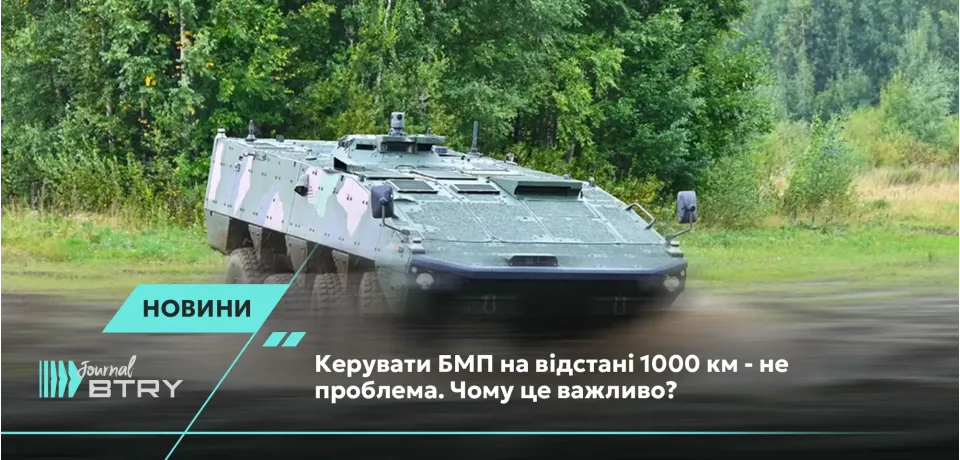
28/08/2026
Operating an infantry fighting vehicle (IFV) from a distance of 1,000 km is not a problem. Why is this important?
BTRY.ENERGY offers news and articles in Ukrainian with a focus on preserving Ukrainian identity, citizens' rights, and t...
Consultation
Need more information?
Would you like to learn more about BTRY.ENERGY or get a personal consultation - fill out the form and we will contact you


