
 Product Catalog
14.05.25
Inside every battery is a process that is more complex than an engine. And we're going to show you how it works. It will be really interesting
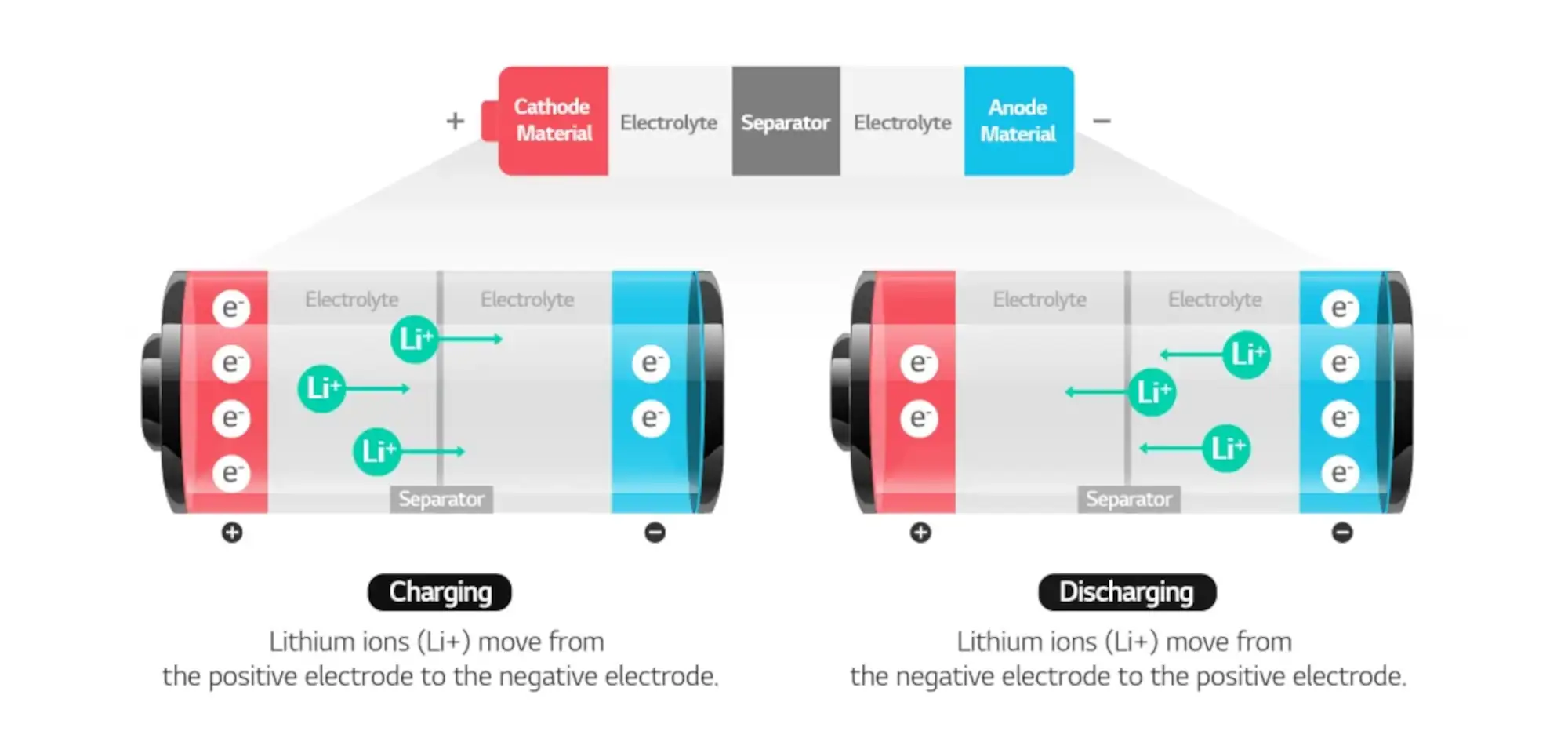
Batteries are a crucial component of modern technologies. Their basic principle of operation involves generating electrical energy through a chemical reaction, where electrons move from one material to another, creating a current. To better understand how batteries are made, let’s look at the key stages of their production and the raw materials used.
Principle of Battery Operation
The core of battery operation is the movement of electrons, which are negatively charged particles. They move from the anode to the cathode, initiating a chemical reaction that generates electric energy. The anode and cathode are two different metals connected by an electrolyte—a substance capable of conducting electrons. Electrons are more strongly attracted to the cathode than to the anode, which causes their movement and, consequently, the generation of electric current.
Battery Manufacturing
The battery production process can be divided into three main stages.
Electrode Fabrication:
- At this stage, a slurry is created from active materials, a solvent, and other chemical components.
- The slurry is applied to a metal foil (copper for the anode and aluminum for the cathode), which is then dried to remove the solvent and fix the active material.
- The foil with the applied layer passes through heated elements to ensure uniform thickness and coating density.
- The finished foil is cut into pieces of the required size.
Cell Assembly:
- The electrodes are cut into rectangular shapes.
- The anode, separator, and cathode are alternately stacked in the battery case.
- The electrodes are connected to terminals, and the case is sealed, leaving space for electrolyte filling.
Formation and Quality Control:
- The battery is charged for the first time and undergoes a series of tests.
- It is processed to remove gases and improve efficiency.
After quality inspection, the battery can be used as intended.
Raw Materials for Battery Production
Key battery components include various metals, electrolytes, and other materials:
- Metals: Lithium, cadmium, nickel, iron, zinc, and manganese are the main metals used in batteries. Lithium is especially important for lithium-ion batteries used in electric vehicles.
- Electrolytes: Facilitate electron flow between the anode and cathode. These can be aqueous or organic solutions containing various salts.
- Graphite: Used for electrode production and aids in removing gases generated during electrochemical reactions.
- Plastics: Polypropylene and polyethylene are used to make separators and battery casings.
Lithium-ion batteries are most commonly used in electric vehicles, offering greater driving range and high efficiency. Among lithium-ion batteries, lithium-nickel-cobalt-manganese (NMC) types are the most popular. In manufacturing such devices, special attention is paid to quality at every stage.
Environmental Aspects of Battery Manufacturing
Despite their important role in modern technology and the transition to more sustainable energy, battery production is associated with several environmental challenges. This is a complex issue that requires attention throughout the product's life cycle. From raw material extraction to disposal of spent cells, every stage of production must be optimized to minimize environmental impact. Implementing stricter standards, developing new technologies, and transitioning to a closed-loop recycling system are key steps toward creating a sustainable and environmentally friendly battery industry.
Battery production is a complex and high-tech process that requires precision and the use of high-quality raw materials. Modern batteries, especially lithium-ion ones, play a key role in technological advancement by providing reliable and long-lasting power for a variety of devices and vehicles. Ongoing development and improvement of battery manufacturing technologies allow the creation of more efficient and eco-friendly energy sources.
News and Reviews



01/09/2026
Top News for the Morning of September 1, 2026. Russia is using tactics of attrition against Kyiv
BTRY.ENERGY offers news and articles in Ukrainian with a focus on preserving Ukrainian identity, citizens' rights, and t...

31/08/2026
Pentagon: Arsenal to be expanded
BTRY.ENERGY offers news and articles in Ukrainian with a focus on preserving Ukrainian identity, citizens' rights, and t...

31/08/2026
Three major American publications focus on Ukraine. Why does this matter?
BTRY.ENERGY offers news and articles in Ukrainian with a focus on preserving Ukrainian identity, citizens' rights, and t...

31/08/2026
Top News for the Morning of August 31, 2026. The world has finally entered a global conflict
BTRY.ENERGY offers news and articles in Ukrainian with a focus on preserving Ukrainian identity, citizens' rights, and t...

28/08/2026
A new nuclear technology: micro-reactors. Why is this important?
BTRY.ENERGY offers news and articles in Ukrainian with a focus on preserving Ukrainian identity, citizens' rights, and t...
28/08/2026
Operating an infantry fighting vehicle (IFV) from a distance of 1,000 km is not a problem. Why is this important?
BTRY.ENERGY offers news and articles in Ukrainian with a focus on preserving Ukrainian identity, citizens' rights, and t...
Consultation
Need more information?
Would you like to learn more about BTRY.ENERGY or get a personal consultation - fill out the form and we will contact you


