
 Product Catalog
26.11.25
The fundamental unit is the “discharge/charge cycle.” Why is it important to understand the processes and factors that affect the battery’s lifespan?
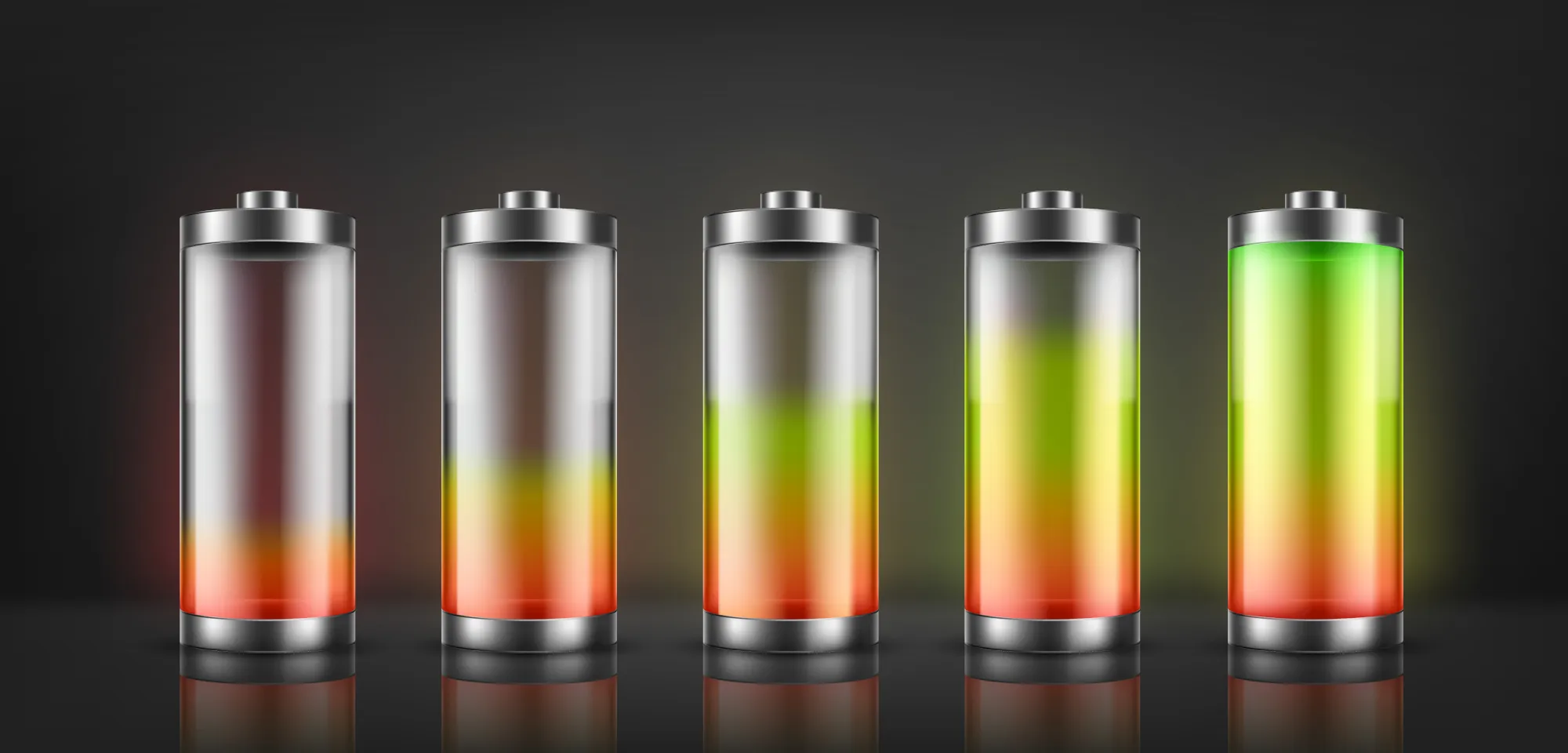
Definition of the Discharge/Charge Cycle
A discharge/charge cycle (or simply cycle) is a complete process during which a battery goes from a fully charged state to a fully discharged state, and then is recharged back to its initial level.
However, as noted by Battery University, there is no single standardized definition:
- Common understanding: A full discharge of a charged battery followed by recharging.
- Manufacturer’s definition: Often the formula of 80% depth of discharge (DoD) is used. This means the battery is discharged only to 80% of its available energy, leaving 20% in reserve. Manufacturers claim this is closer to real operating conditions, since batteries are rarely fully discharged.
- Actual cycle: A cycle is considered complete when the total discharge of the battery reaches 100% of its capacity. For example, if a battery is discharged from 100% to 50% (50% DoD) and recharged, then discharged again from 100% to 50%, this adds up to one full cycle (50% + 50% = 100%).
Mechanism of Operation
The chemical process underlying the cycle is the movement of lithium ions between two electrodes — the anode and the cathode — through the electrolyte and separator.
There are two stages in the cycle: discharge (Usage) and charge (Storage). During these stages, corresponding chemical processes occur. First, when the battery delivers energy, lithium ions move from the anode to the cathode, creating an electron flow. Second, the reverse process occurs when the battery stores energy, with lithium ions moving back from the cathode to the anode.
Cycle as a Lifespan Resource (Cycle Life)
Cycle life is the total number of discharge/charge cycles a battery can undergo before its capacity significantly degrades.
Typically, the end of a battery’s service life is defined as the point when its capacity falls below 80% of its initial nominal capacity.
Factors Affecting Cycle Life
Battery lifespan is influenced by two main types of aging: cyclic and calendar.
- Depth of Discharge (DoD)
The most significant factor. The smaller the depth of discharge, the more cycles the battery can withstand. Partial cycles (e.g., 20% DoD) cause less mechanical and chemical stress on the electrodes compared to full cycles (100% DoD). - Temperature
Critical influence. High temperatures significantly accelerate degradation. The optimal temperature for most Li-ion batteries is around 20–25°C. Operation at elevated temperatures (e.g., above 45°C) accelerates aging and electrode damage. - Discharge/Charge Current (C-rate)
High currents shorten lifespan. Excessive currents generate more heat and mechanical stress in electrode materials, accelerating degradation. - State of Charge (SoC)
Operation at high or low SoC is stressful. Long-term storage or operation at 100% or 0% charge is more harmful than maintaining charge in the mid-range (e.g., 20%–80%).
Degradation Mechanisms (Aging)
Capacity and power degradation during cycles occurs through several key chemical processes:
- Formation of SEI layer (Solid Electrolyte Interphase): During the first cycles, a protective layer forms on the anode. Over time, this layer continues to grow, consuming active lithium and electrolyte, which leads to irreversible capacity loss.
- Cracking of active material: Continuous expansion and contraction of electrodes during lithium-ion intercalation/deintercalation causes mechanical stress and microcracks. This worsens the contact between active material and current collector.
- Electrolyte oxidation: At high voltages (close to 100% charge), the electrolyte can oxidize, which also leads to loss of active lithium and increased internal resistance.
Recommendations for Extending Cycle Life
To maximize the lifespan of batteries, it is recommended to:
- Avoid full cycles (100% DoD): Try not to discharge the battery to 0% and not to keep it constantly charged to 100%.
- Use partial cycles: Frequent, shallow cycles (e.g., discharge from 80% to 20%) are less stressful and allow achieving a greater total number of equivalent full cycles.
- Control temperature: Avoid overheating and operation at extremely low temperatures.
News and Reviews



01/09/2026
Top News for the Morning of September 1, 2026. Russia is using tactics of attrition against Kyiv
BTRY.ENERGY offers news and articles in Ukrainian with a focus on preserving Ukrainian identity, citizens' rights, and t...

31/08/2026
Pentagon: Arsenal to be expanded
BTRY.ENERGY offers news and articles in Ukrainian with a focus on preserving Ukrainian identity, citizens' rights, and t...

31/08/2026
Three major American publications focus on Ukraine. Why does this matter?
BTRY.ENERGY offers news and articles in Ukrainian with a focus on preserving Ukrainian identity, citizens' rights, and t...

31/08/2026
Top News for the Morning of August 31, 2026. The world has finally entered a global conflict
BTRY.ENERGY offers news and articles in Ukrainian with a focus on preserving Ukrainian identity, citizens' rights, and t...

28/08/2026
A new nuclear technology: micro-reactors. Why is this important?
BTRY.ENERGY offers news and articles in Ukrainian with a focus on preserving Ukrainian identity, citizens' rights, and t...
28/08/2026
Operating an infantry fighting vehicle (IFV) from a distance of 1,000 km is not a problem. Why is this important?
BTRY.ENERGY offers news and articles in Ukrainian with a focus on preserving Ukrainian identity, citizens' rights, and t...
Consultation
Need more information?
Would you like to learn more about BTRY.ENERGY or get a personal consultation - fill out the form and we will contact you


